Being a search marketer, business owners often ask me to point out websites that I think are doing a good job at SEO. They want real world examples of who's doing it right so they can see SEO best practices at work. When it comes to websites that are mastering SEO, one site in particular always comes to mind: Wikipedia.
Wikipedia has done a remarkable job at mastering some of the critical elements of SEO, such as having a strong information architecture (or site structure), effective link development across the site and strong keyword optimization on every page. There's a good reason why Wikipedia ranks in the top three for almost every search query on the Web, and implementing good SEO is a major factor.
So let's take a closer look at Wikipedia and see what it is exactly that they do right for SEO.
Wikipedia Understands the Importance of Keywords
Good SEO starts with keywords and Wikipedia knows it. Keyword research is the foundation of every search engine marketing campaign. If you don't have the right keywords in your content, your page is not going to be relevant to a searcher's query and will not get returned in the search results, let alone rank highly.
Here's a search query I ran for the keywords "venture capital" (NOTE: I'll use this term throughout the article as an example). Not surprisingly, Wikipedia ranks #1.
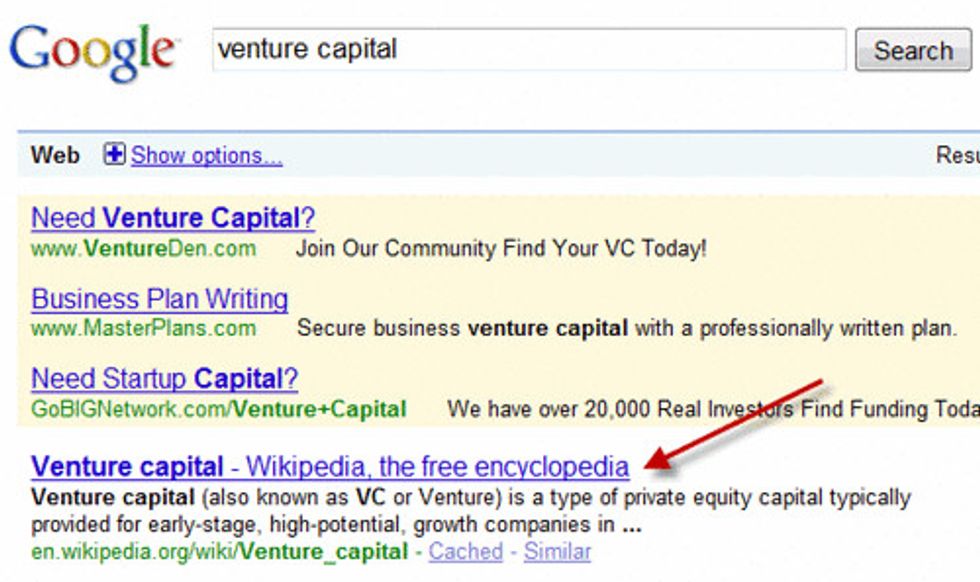
Now when we examine the "venture capital" page on Wikipedia, there are various SEO elements and best practices that aid this page in this keyword ranking well in the search engines. I've numbered them so we can discuss them in greater detail below. Here's a look at the venture capital page.
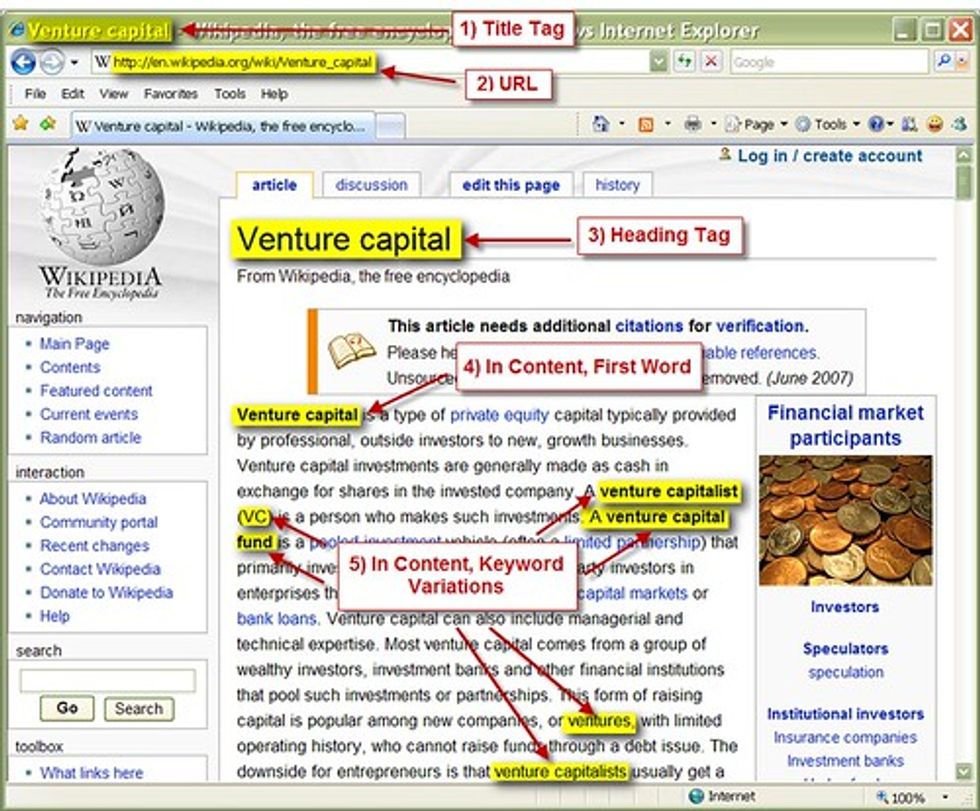
Wikipedia maximizes its SEO efforts and integrates target keywords in the following critical regions:
1) Title tag: This is the primary focus of each Web page. It’s the first line of content users see in the search results (which is both blue and clickable: see the first image). The Title Tag is one of THE most important pieces of content on your website. So it’s imperative that your target website keywords live here.
2) URL: Another key element of SEO is the URL structure or the address of your Web page. Here we see Wikipedia following SEO best practices and using the primary keywords as the file name: "Venture_Capital."
3) Heading Tags: #3 is the heading tag on the venture capital page. Heading tags are headlines within your content, which are produced by the HTML tags H1, H2, H3, etc. This is a prominent piece of on page copy, so you want to include your target keywords to demonstrate relevance to the search engines.
4) Initial Keyword: It's important to establish the theme of the article by mentioning (and bolding) the target keywords as soon as possible and throughout the content. In this example, Wikipedia sets the tone for this article and uses the target keyword right off the bat, as the first word.
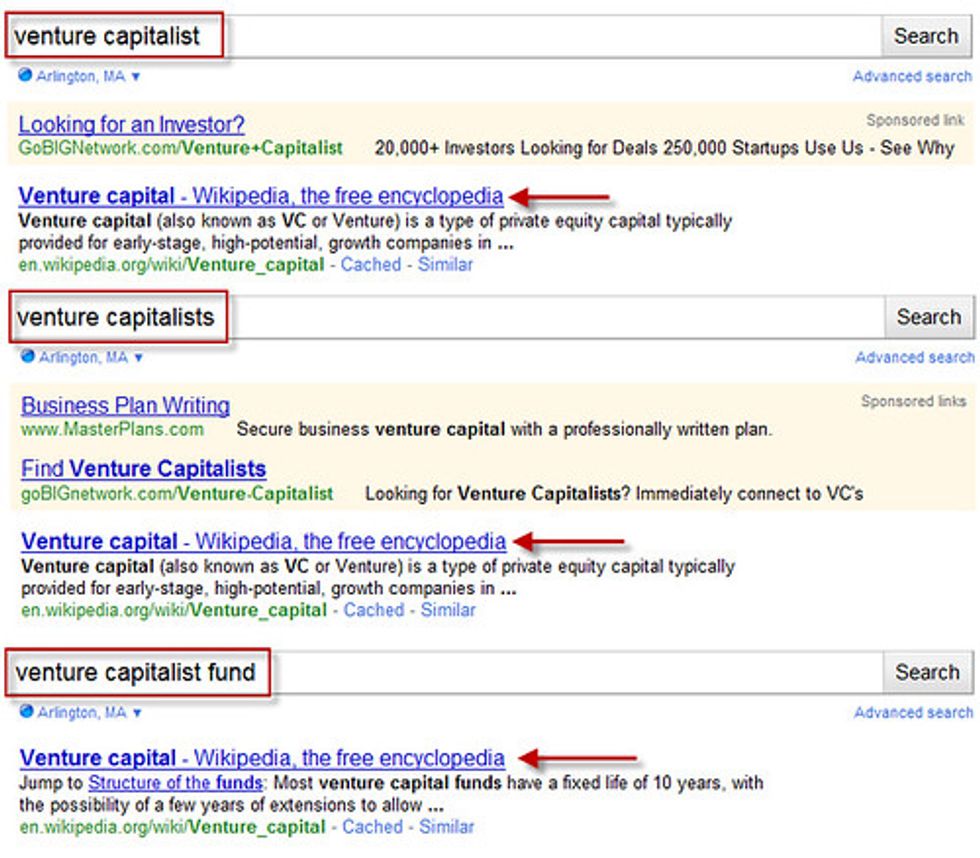
5) Keyword Variations: After performing keyword research and optimizing a page for Web keywords for SEO, it's a good idea to use 5 to 10 close variations of your target keywords (this including plurals, gerunds, stemming, different verb tenses and closely-related modifiers). That way, you’re targeting not just your core keywords, but you’re also leveraging the long tail of search, so your page shows up on a range of search queries rather than just one or two.
For example, on the venture capital page Wikipedia targets the search engine keyword "venture capital," as well as the variations "venture capitalist," venture capital fund," "venture capitalists." As a result, this document ranks for not just the primary keyword, but also for each variation.
Wikipedia’s 'Pyramid of Keywords': Organizing Content for SEO
Developing a strong information architecture (or site structure) is also critical for good search engine rankings. Information architecture simply refers to the way you organize and structure your website’s information, content or Web pages.
Wikipedia is the master of creating a site structure that is Google-friendly. They accomplish this by following a valuable SEO technique for developing effective site architectures known as the "pyramid of keywords." Creating a pyramid of keywords involves two steps:
- Identify a portfolio of relevant keywords to target for your website
- Establish a keyword hierarchy/pyramid, whereby you organize and structure your site navigation into tiers. You begin with the most competitive, higher traffic, popular keywords at the top or your site navigation (on say the home page or in your top-level navigation), followed by the next tier of keywords of mid-level competition, and building out the base of your pyramid with less competitive, more granular keywords, also known as long tail keyword groups.
Let’s look at the pyramid in action using the venture capital page on Wikipedia again. The keyword "Venture Capital" is not a hyper-competitive term (relatively speaking), so it doesn’t live at the top of the pyramid on Wikipedia. It lives in the middle tier of the pyramid, just a few clicks away from the home page in Wikipedia’s section on "Finance," which lives higher up in the navigation because it’s a much more general and competitive keyword.
So the site structure follows this path of clicks: Finance>Private Equity>Venture Capital>Venture Capital Firms>etc.
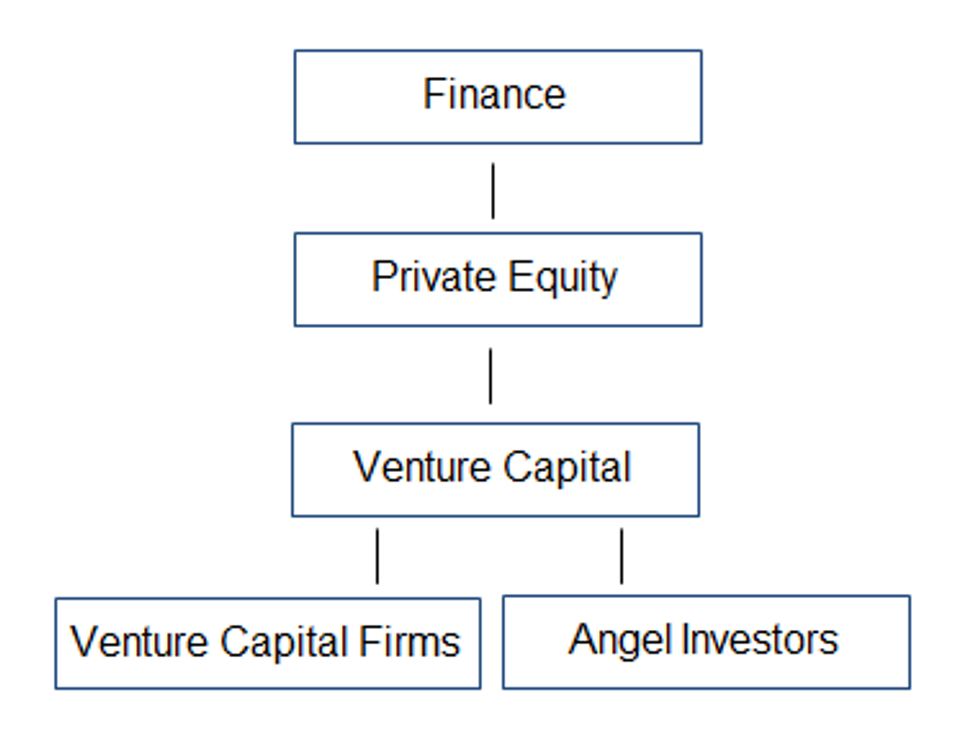
Now, it’s not illustrated here, but below the venture capital firms’ page on Wikipedia live even more granular keyword pages, such as content for specific venture capital firms, like Sigma Partners and Bain Capital.
So, you may be asking, why is this pyramid of keywords necessary for good SEO? It depends largely on inbound links.
Quick Primer on the Importance of Links for SEO
In short, inbound links (links to your website from other websites) are essential to good SEO rankings. Wikipedia, for example, has almost 100 million inbound links. With the natural order of the Web, your home page attracts the most links (this is where people generally link to you when they mention your site). That means it contains most of the "link juice" (a term used in SEO link development for the authority and trust of a website).
To compete on competitive keywords, you’re going to need all this link juice, so your strategy is to concentrate your home page on highly competitive terms. Meanwhile, as you move down your site structure, away from your home page, your pages become less and less powerful as the "link juice" gets dispersed and diluted. This means you should target less popular keywords on these deeper pages because they don’t need as much link juice to rank since there’s less competition in the search results.
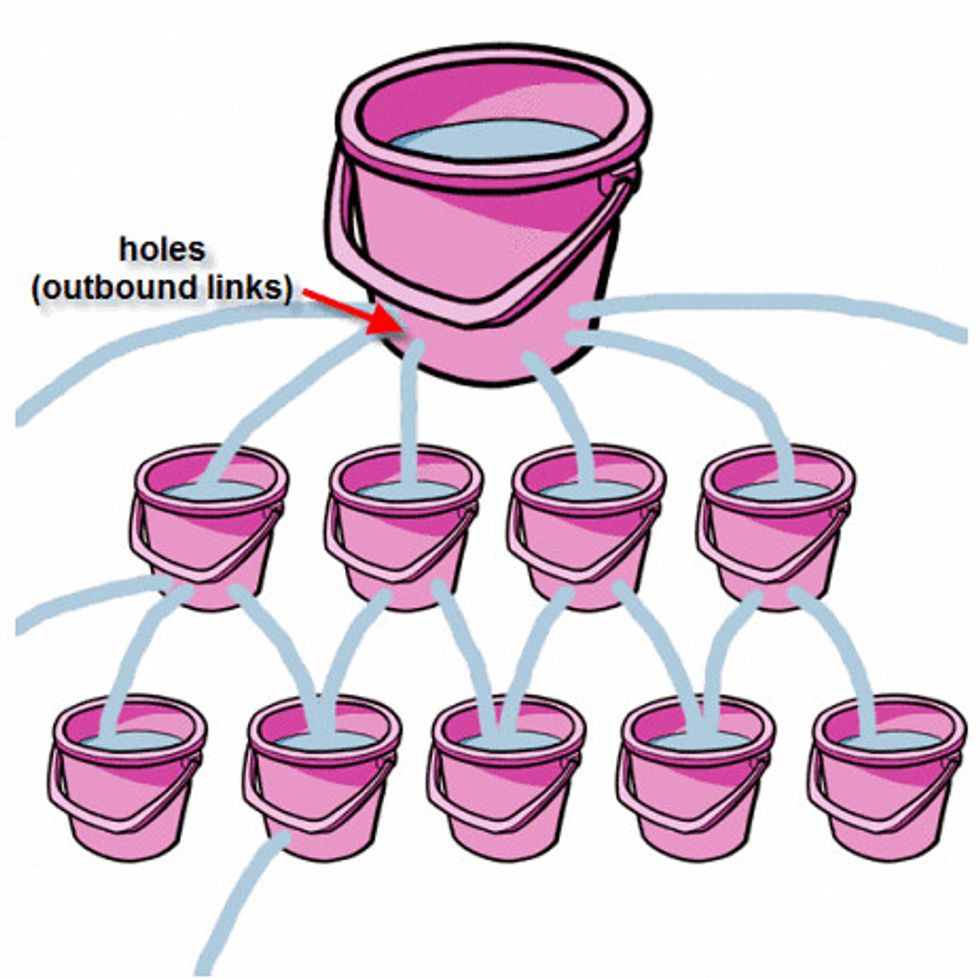
In the above image, the pails represent pages and the holes or leaks are links that funnel link juice throughout a site (or to other sites). So as you can see, inbound links (and the "link juice" they transfer) are important to SEO. You can read more about attracting inbound links in this article on how to build backlinks.
But Google doesn’t just count links pointing to your website from other sites. It also counts how your pages are interlinked using keyword-rich anchor text, which we’ll cover in the next section.
Internal Linking the Wikipedia Way
Now as I pointed out previously, Wikipedia attracts a lot of inbound links, but they also use a lot of internal anchor text links. Anchor text is the text that is linked to on one web page, which, when clicked, brings visitors to a new page. Internal anchor text links connect users to pages on the same website.
Internal links are important for 3 reasons:
- They signal relevance: The anchor text of a link tells the search engines what they page it’s linking to is all about. This sends a strong signal to Google that when someone is searching for a term such as "venture capital," that our page is a good resource. When creating these text links on your website (or if someone else is linking to your website), you want to use your target keywords. Also, remember to use the target keywords for the page the user is being sent to, not the ones that are the focus of the page the user is on currently.
- They funnel link juice throughout your website: and move link juice from link rich pages to link poor pages
- They are good for usability: offering users a path to deeper content on your website
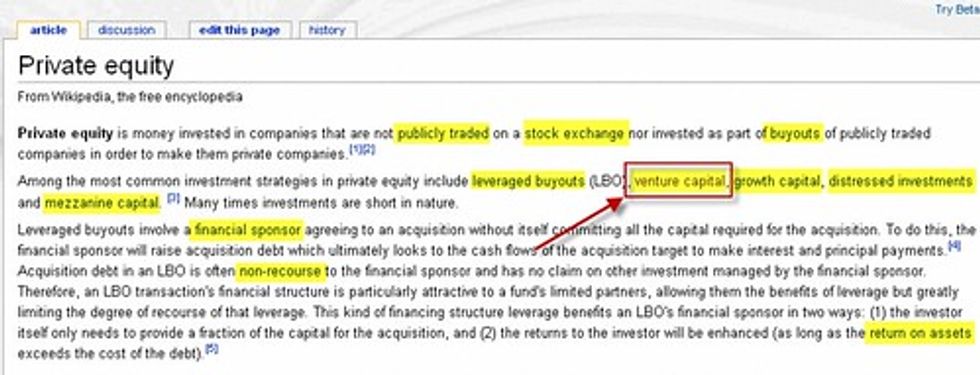
Notice how Wikipedia links to the venture capital page with the anchor text keyword "venture capital." Also, notice how many other internal links are on this page (I’ve highlighted them all). Each links to a corresponding page about that keyword/topic with the specific anchor text of that corresponding page, which flows link juice and relevance to that page, aids users in getting more information on that topic, but also helps that page rank for its target keyword.
Conclusion
If you’re starting your journey in search engine optimization or looking to improve your skills, I highly recommend you pay attention to what Wikipedia is doing for SEO. Wikipedia provides site owners and marketers with a clear model of what Google likes and rewards in the search results. Wikipedia is a ranking machine and by following the site’s lead you can study, imitate and implement their SEO strategies on your own website and enjoy ranking success in your target search verticals.