In large-scale litigation, one process has quietly consumed a bigger share of legal budgets than almost any other: document review. When a major lawsuit, class action, regulatory investigation, or other document-intensive matter gets underway, millions of emails, messages, and other files must be collected and analyzed to determine which are relevant, which are privileged, and which must be produced to the other side. The initial stage of that analysis—known in the industry as "first-pass review"—has traditionally been performed by hundreds of junior associates or even contract attorneys, often located offshore, reading documents one at a time.
That model is now being replaced. Agentic AI, meaning autonomous software agents that can read, reason about, and code documents at scale while documenting their rationale, is doing to document review what eDiscovery platforms did to paper productions two decades ago. It is not an incremental improvement in efficiency. It is a change in who, or what, does the work.
This article explains what first-pass review is and why it has been so costly, how agentic AI is changing it, why experienced lawyers become more important rather than less, and the key questions that general counsel, law firms, and litigation service providers should be asking as they evaluate this shift.
1. What Is First-Pass Review and Where Does It Matter?
Document review is the stage of litigation during which a party's lawyers analyze the electronically stored information (emails, chat messages, contracts, spreadsheets, and more) that may be relevant to a dispute. It also involves sifting through hard copy files that might exist, but these files are often scanned to become electronic information. The first pass is the initial sort: each document is coded for responsiveness (is it relevant to the matter or to specific requests from the other side?), privilege or confidentiality (is it protected by attorney-client privilege or work product or is otherwise confidential and potentially protected from disclosure?), and issues (which claims or defenses does it relate to?). A smaller group of senior attorneys then performs quality control and makes the final calls.
It is worth being precise about where this applies. First-pass review is not a feature of most litigation. The typical personal injury case, employment dispute, or small commercial matter involves a manageable volume of documents that the case team reviews directly. First-pass review at scale is a phenomenon of the high end of the market: complex commercial litigation, securities and antitrust cases, product liability, internal and government investigations, and regulatory matters such as merger "second requests." In those matters, a single custodian's mailbox can hold hundreds of thousands of documents, and review costs routinely run into the millions of dollars, frequently the largest line item in the litigation budget.
Cases are often won and lost based on what is contained in the electronic files of a corporation and, more importantly, understanding what is contained within the mass of information before learning about it for the first time at a party’s deposition when the opposing lawyer drops a bad document on the table in front of the deponent.
That is the segment where agentic AI is transforming first, and it is where the economics are most dramatic.
2. Why the Traditional Model Is Breaking Down
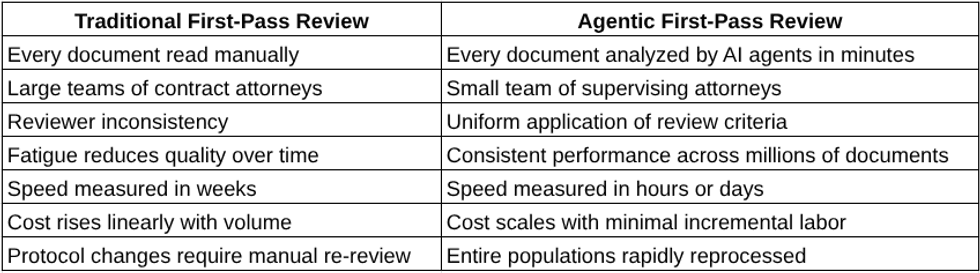
Manual first-pass review has structural weaknesses that no amount of project management can fix:
- Cost scales with data. Every additional gigabyte means more reviewers, more hours, and more fees, and data volumes only grow.
- Inconsistency. Put the same document in front of ten contract attorneys and you will frequently get different coding decisions.
- Fatigue. A reviewer's 400th document of the day does not get the attention their 40th did, and the degradation is difficult to detect.
- Slow start, slow finish. Recruiting, onboarding, and training a large review team can take weeks before a single document is coded.
- Painful mid-course corrections. When responsiveness criteria change, as they almost always do, large portions of the population must be manually re-reviewed at nearly full cost.
- Management overhead. Large reviewer pools require project managers, team leads, and turnover management, all of which add cost without adding legal judgment.
None of these are people problems. They are architectural problems. The model itself, with many humans performing repetitive cognitive work at scale, is the constraint.
3. What Agentic AI Review Actually Does
Agentic review replaces the human first pass with a system of AI agents that analyze every document in a population, while experienced attorneys supervise, validate, and decide.
The distinction from earlier technology matters. Technology-assisted review (TAR) and predictive coding, which courts have accepted for over a decade, rank or classify documents statistically based on attorney training sets. Agentic systems go further: agents read each document, apply the review protocol as written, make a coding decision, and record a supporting rationale, much like a human reviewer would, but uniformly, tirelessly, and in minutes rather than weeks.
In practice, the workflow looks like this:
- The review protocol (responsiveness criteria, privilege rules, issue tags, confidentiality designations) is encoded as instructions the agents apply to every document.
- Agents analyze the full population immediately, with no recruiting or training delays.
- Every decision is logged with the agent's reasoning, creating a document-by-document audit trail.
- Close calls, potentially privileged material, and hot documents are routed to supervising attorneys.
- Attorneys perform validation sampling, quality control, and the legal judgment calls that require a lawyer.
The leading platforms also orchestrate multiple AI models, selecting the best available for each task and adding new ones as they prove out, so review quality tracks the state of the art rather than a single vendor's engine.
4. The Technology Landscape
Agentic review is the leading edge of a broader transition moving through legal technology, and the landscape shows how quickly the shift is happening.
In eDiscovery, the established platforms have moved decisively. Relativity has made its generative AI review tools, aiR for Review and aiR for Privilege, features of its cloud platform, making AI-driven review the baseline expectation rather than a premium add-on. DISCO has launched agentic capabilities designed to process millions of documents autonomously, and Everlaw has embedded AI review and privilege assistance directly into reviewer workflows. Consolidation among AI-first specialists underscores the trend: the labor-arbitrage model is giving way to a technology-plus-expertise model.
Beyond litigation, companies such as Legora, Luminance, Flank, and Filevine are moving agents into orchestrated legal work (contract review, negotiation workflows, routine legal requests, and matter management) with attorneys supervising rather than executing. These platforms are normalizing the supervisory model across the profession: lawyers are becoming comfortable directing agents, validating their output, and owning the judgment layer.
5. The Business Case for Agentic AI: Cost, Speed, and Quality
The advantages of agentic AI fall into three categories that every litigation budget holder cares about.
Lower cost. Because the marginal cost of reviewing another 100,000 documents is computational rather than human, agentic review can reduce first-pass attorney labor by an estimated 70% to 90%. Costs scale with volume efficiently rather than linearly, which changes both client budgets and provider margins.
Faster time to production. Agents begin processing large populations immediately. Review timelines compress from weeks to days, or even hours for smaller populations. In matters with aggressive deadlines, regulatory second requests, or rolling productions, that speed is a strategic advantage, not a convenience.
Higher and more consistent quality. This is the point most often missed in the cost conversation. Agents apply the same standards to document one and document one million: no fatigue, no drift, no variation between reviewers. And because every decision carries a recorded rationale, quality is measurable and auditable in a way human first-pass review has never been.
6. Why Experienced Lawyers Matter More, Not Less
The most common objection to agentic review is also the most misplaced: "You cannot take lawyers out of document review." Correct, and agentic review does not. It changes what lawyers do, and it raises the value of experience. A population of ten million documents contains thousands of plausible narratives; the case can turn on finding the right one. An attorney with 20 or 30 years of litigation and investigations experience carries an inherent know-how no model possesses: which custodian to pressure-test, which date range hides the pivot point, which routine-looking email pattern signals something the other side hopes nobody notices. Agents can answer questions at superhuman speed and scale, but the magic happens when a deeply experienced litigator is positioned to ask the right questions at the right moment. The value of the human is not merely oversight; it is knowing what to ask of the data, and when.
Consider Formula 1. A modern F1 car is among the most sophisticated machines ever built, yet nobody wants to watch driverless Formula 1. People want Lewis Hamilton in the car, in control, reading the race, supported by a pit wall making split-second strategic calls. The car makes Hamilton faster than any driver in history could otherwise be; Hamilton makes the car mean something. Strip out the driver and the pit crew and you have impressive machinery going in circles. The same logic applies to litigation, with far more than entertainment at stake. The agents are the car; the experienced litigator is the driver; the supervising team is the pit wall. Speed without judgment wins nothing.
In practical terms, attorney work in an agentic workflow concentrates on protocol design, statistical quality control, privilege determinations, hot-document analysis, exception handling, and final production and defensibility decisions. A supervising attorney adjudicating exceptions and validating samples is doing law; a contract attorney coding their 4,000th routine email of the week is doing labor.
7. Defensibility: The Audit Trail Advantage
Any change in review methodology must survive scrutiny from opposing counsel, regulators, and courts. Here, agentic review has an underappreciated structural advantage: auditability.
In traditional review, a coding decision is a checkbox; the reasoning behind why a particular reviewer coded a particular document a particular way on a particular afternoon is essentially unknowable. In agentic review, every decision is recorded with its rationale. That produces a consistent, document-level record of how the protocol was applied, the ability to demonstrate uniform treatment of similar documents, and transparent, reproducible validation statistics. If a coding rule is disputed mid-matter, the affected population can be identified and reprocessed in hours rather than re-staffed for weeks, turning what was once a budget catastrophe into a routine operation.
Courts spent years getting comfortable with technology-assisted review because statistical validation proved more defensible than the fiction that armies of tired reviewers were making consistent decisions. Agentic review extends that logic with a review record more transparent than anything human review ever produced. Parties should still negotiate electronically stored information protocols thoughtfully and involve counsel experienced in defensibility. But the trajectory is clear.
8. Winners and Losers in the Industry Shakeout
The shift has sharp competitive implications. Providers whose business model depends on reselling large volumes of hourly reviewer time face the disruption that travel agencies and stock brokerages once faced.
The large legal services providers that have dominated document review for two decades built their economic engines on the scale of people: thousands of billable contract reviewers and revenue models where more documents mean more hours mean more fees. That makes agentic review a classic innovator's dilemma. Genuinely embracing a model that cuts first-pass labor by an estimated 70% to 90% means cannibalizing their largest revenue line and repricing their flagship service, while quarterly targets still depend on keeping reviewers busy. Add the realities of businesses that size (long product cycles, private equity return expectations, and layers of process between customer demand and delivery change), and the incumbents are structurally slow to react to what clients are now asking for.
That gap is where smaller, agent-first providers are gaining ground. With no legacy review revenue to protect and no large bench to keep utilized, they can price on outcomes rather than hours, adopt the best AI models as they emerge, and reconfigure delivery in days rather than fiscal years. History suggests how this plays out: in every service industry disrupted by automation, the incumbents' scale became their anchor, and share went to entrants willing to sell the disruption rather than resist it.
9. Key Questions to Ask Before Adopting Agentic Review
General counsel, litigation partners, and eDiscovery leaders evaluating agentic review should ask:
- How is the review protocol encoded, and who validates that agents are applying it correctly?
- What is the validation methodology, including sampling design, precision and recall, acceptance thresholds?
- How are potentially privileged documents identified, protected, and routed to attorneys?
- What does the audit trail contain, and will it withstand meet-and-confer and court scrutiny?
- Where is client data processed and stored, and what security certifications apply?
- What percentage of the population typically requires human review?
- What does mid-review reprocessing cost, and how fast is it?
- How does pricing compare to fully loaded human review costs?
Treat vague answers on validation and auditability as disqualifying. Defensibility is the whole game.
10. What This Means for Litigation
First-pass review as the high end of the market has known it, with rooms full of junior associates and/or contract attorneys reading documents nobody will ever look at again, is ending, and it will not be mourned. It was slow, expensive, inconsistent, and a poor use of legal training.
What replaces it is a model in which agents do the reading and attorneys do the judging: reviews in days rather than weeks, costs that scale computationally rather than linearly, and quality that is uniform across millions of documents and provable through statistics rather than assumed through staffing. The transition will not be uniform, and human review will persist where regulation or negotiated protocols require it. But the direction is no longer in doubt. Just as no serious litigator today would propose manually reviewing paper in place of an eDiscovery platform, within a few years none will propose staffing 200 contract attorneys for a first pass that agents can perform in an afternoon, and with a better audit trail.
The firms, providers, and legal departments that embrace that reality early will hold a durable advantage in cost, speed, and quality. The ones that wait will be competing against them.
For a detailed look at how one agentic first-pass review platform is built and supervised in practice, see Stella Legal's overview of Atlas.
Related Articles:
- 2026 AI Trends and Insights for In-House Counsel (Thomson Reuters)
- Stella Legal Launches M&A Division
- A Guide to AI-Powered Legal Technology Companies
- The LegalTech AI Company Seeing Enormous Traction
About the Authors
Tyson Ballard is the founder and CEO of Stella Legal, a legal technology company focused on enabling AI change in legal and procurement teams, and the creator of Atlas, an agentic eDiscovery product. He has held leadership roles at Consilio, SYKE, and Cognia Law, advising enterprise legal teams on contract lifecycle management, AI implementation, and legal operations. He is the host of the legal technology podcast Outlawed. He can be reached through LinkedIn.
Richard D. Harroch is a Senior Advisor to CEOs, management teams, and Boards of Directors, and an expert on M&A, venture capital, startups, and business contracts. He was Managing Director and Global Head of M&A at VantagePoint Capital Partners, a venture capital fund in the San Francisco area, with a focus on internet, digital media, AI, and technology companies. He was previously a corporate and M&A partner at the law firm of Orrick, Herrington & Sutcliffe, and is the author of several books on startups and entrepreneurship, including a Wall Street Journal-bestselling book on small business and a 1500 page Bloomberg treatise on mergers and acquisitions of privately held companies. His articles have appeared online in Forbes, Fortune, MSN, Yahoo, Fox Business, and AllBusiness.com. He is an advisor to Stella Legal and other tech companies. He can be reached through LinkedIn.
William (Bill) McManus is a senior legal industry executive at Stella Legal, where he focuses on litigation strategy, agentic AI workflows, and AI-driven deal execution. A graduate of the University of Missouri-Kansas City School of Law, he brings more than 34 years of experience across six industries and three continents, including leadership roles in legal managed services at UnitedLex. He is based in Phoenix, Arizona. He can be reached through LinkedIn.
Copyright © by AllBusiness.com. All Rights Reserved.