As a learning specialist and business consultant for over 35 years, I have found that in order to create long-term businesses success, one has to understand what it means to be a leader and what it means to build a business culture. Both of these require getting onto the playing field and getting down in the mud. Effective leadership skills cannot be successfully mastered in a classroom. Building a corporate culture that seamlessly implements business strategies cannot be created on a chalkboard. Having taught organizational leadership in a college classroom environment, I can tell you that such a learning approach alone can only bring forth dismal failure.
I have found an accomplice to work with me in training emerging leaders and creating productive work cultures. A dog. Not just any dog. Beretta, my Great Dane therapy dog. I have a history of living with canines, but this four-legged creature has provided insights into leadership and employee engagement that are so straightforward and common sensical, I wondered why it took so long to become noticed.
[caption id="attachment_21703" align="alignright" width="208"]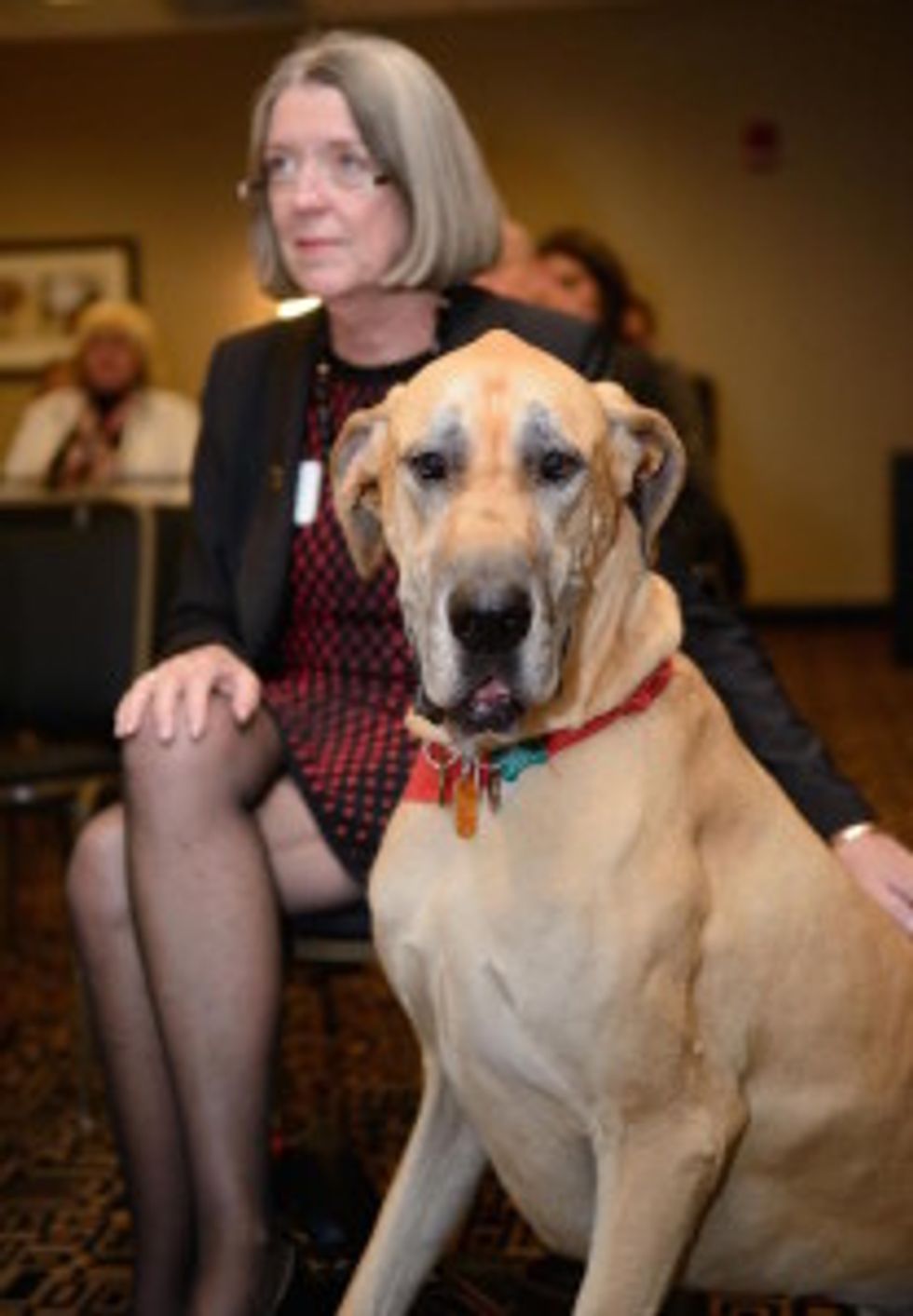 The author and Beretta[/caption]
The one aspect of my work with Beretta as a therapy dog, visiting hospitals and workplace environments is the ability to give back. To pay it forward. We find ourselves embracing a purpose with meaning and a mission bigger than ourselves that is an opportunity to connect with our community. Watching Beretta engage with patients, clients, and staff has taught me valuable lessons that I can share about the importance of purpose, embracing a pack mentality, and living in the moment.
Through our therapy visitation work and from my business experience, I have found that there are three foundational values to embrace if you are trying to align an organizational culture with strategies. Smart leaders know this. Understanding what management values and how these translate into strategic objectives play a major role in how successful the company’s business trajectory will be. Not understanding the company’s core values leads to a misplaced focus by the workforce.
These three values—authenticity, integrity, and trust—when woven together throughout the fabric of the work environment will produce high-quality results from confident, motivated, and engaged employees. Having the values held by the company modeled by its leaders leads to a workplace becoming energized and employees becoming more positively engaged.
Providing emotional support is another important aspect for creating a healthy, productive workforce. In working with Beretta, I witness this firsthand. Offering emotional support is one of the mainstays of this gentle Great Dane’s work. Offices, hospitals, and other places of work can become tense in an instant. Nothing diffuses this tension better than quiet emotional support.
There are several aspects of a dog’s pack mentality that are applicable to creating a successful, highly productive, and purposeful workplace culture. How dogs view their organizational hierarchy in a pack, how they work together as a team, how they create shared meaning, and how they rely on each individual member’s unique strengths, are learned very early as puppies. Ultimately, they build strong supportive and respectful relationships.
The pack as a community of canines can be equated to the organization’s culture of people. The daily behavior and actions of these people ultimately form the rituals and routines that are perpetuated as new employees are hired. The rules of the culture become implicitly translated much the same way that the rules of a canine pack are communicated.
Positive, productive cultures are built over time. So is a well-structured canine pack. A company is only as good as its people. To stay competitive, people have to be inspired. They have to enjoy coming to work. In other words, in today’s business environment, it is imperative to develop a happy workforce with a pack mentality of looking out for one another. When employees arrive at work, they want to know that their voices and ideas will be heard. They want to know someone has their back.
In our corporate culture, it can be easy for employees to become bored, disengaged, discontented, and lackadaisical when daily routine become automatic and mindless. It becomes difficult to stay present and stay focused. Humans tend to worry about what might happen in the future or relive incidents that happened in the past. Work tasks can seem dull and uninspiring.
Dogs are different. Dogs stay focused on the present and don’t obsess about past or future occurrences. As Beretta focuses on each present situation, he inspires those with whom he interacts with his positive, supportive attitude and a generous dose of hope. Especially during his hospital visits. Hope provides the energy and ideas that drive people to change their circumstances. Without hope, goals are lost and motivation is diminished. Hope has the power to make bad news temporary. Hope for the future—maybe even the distant future—is what keeps people focused and moving in a direction that makes sense for their personal welfare or the welfare of the organization.
When Beretta visits hospitals and organizations, people smile. Life seems a little brighter. He has a purpose in life that he is willing to share. Business leaders might revisit what purpose their employees embrace. How do they work together as a pack? Are they focused on the present, lost in past events, or worried about future unknowns? Beretta leave us with this advice: If what you want lies buried, dig until you find it.
Photo credits: Ann Gatty