
contract in which two counter-parties agree to exchange interest payments of differing character based on an underlying notional principal amount that is never exchanged. There are three types of interest swaps: coupon swaps or exchange of fixed rate for floating rate instruments in the same currency; basis swaps or the exchange of floating rate for floating rate instruments in the same currency; and cross currency interest rate swaps involving the exchange of fixed rate instruments in one currency for floating rate in another.
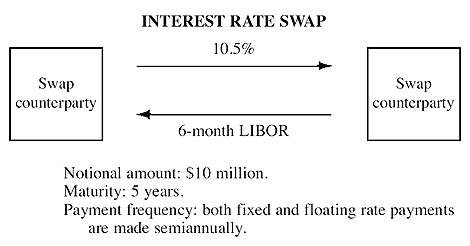
contractual agreement entered into between two counterparties under which each agrees to make periodic payments to the other for an agreed period of time based upon an amount of principal. A common form occurs when a series of payments calculated by applying a fixed rate of interest to a notional principal amount is exchanged for a stream of payments similarly calculated but using a floating rate of interest. Aswap may also be used to effectively change the maturity term of a debt. The two parties are often a corporation and a bank; the bank in turn likely hedges the transaction with a derivative product tied to U.S. Treasury bonds.
contractual agreement between two parties in which they agree to exchange a stream of interest payments on either a fixed rate for a floating rate or a floating rate for a fixed rate. The insurance company is most likely to select a floating rate for a fixed rate because it needs to know exactly what it will be paying in future interest. In this way, the insurance company can hedge its interest rate exposure (risk that interest rates will rise or fall at some stipulated time), reflected by changes in the value of its assets on the balance sheet.

