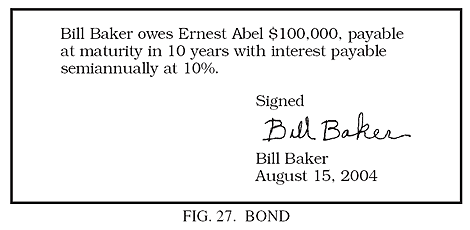
- written promise by a company, government, or other institution to pay the face amount at the maturity date. Periodic interest payments are usually required. Bonds are typically stated in $1000 denominations. Bonds may be secured by collateral or unsecured (debenture). A registered bond has the name of the owner on the issuer's records, whereas the holder of a bearer bondpresents coupons for interest payments. sinking fundbonds require the company to make annual deposits to a trustee. At maturity, the amount in the sinking fund (principal plus interest) is sufficient to pay the face of the bond. From the company's perspective, a bond issue has several advantages over a stock issue. Interest expense is tax deductible, whereas dividend payments are not. During inflation, debt is paid back in cheaper dollars. When bonds are issued at face value, the entry is to debit cash and credit bonds payable. When bonds are issued at a discount, such as with zero-coupon bonds, the entry is to debit cash and bond discount and credit bonds payable. The entry to record the interest each period is to debit interest expense and credit cash.See also bond conversion; bond discount; bond premium.
- cash or property given to assure performance (i.e., contractor depositing a performance bond on a construction project to be completed by a specified date).
- type of insurance compensating employer for employee dishonesty.
interest-bearing or discounted certificate of indebtedness, paying a fixed rate of interest over the life of the obligation, hence the name fixed income security. The issuer is obligated by a written agreement (the bond indenture) to pay the holder a specific sum of money, usually semiannually but sometimes at maturity, as is the case with zero-coupon bonds,and the face value, or par value, of the certificate at maturity. Bonds are long-term obligations, meaning they have maturities of five years, and frequently, ten years or longer.
Price-Discount bond, sold at an Original Issue Discount (OID) from face value or premium bond, sold above par.
obligation to pay. Most federal, municipal, and corporate bonds pay interest twice a year (semiannually). Interest on municipal bonds is generally nontaxable for federal income tax purposes and in the municipality of issue. Interest on federal government bonds is taxable for federal purposes but tax-free for state income tax purposes. corporate bond interest is generally fully taxable.
any interest-bearing or discounted government or corporate security that obligates the issuer to pay the bondholder a specified sum of money, usually at specific intervals, and to repay the principal amount of the loan at maturity. Bondholders have an IOU from the issuer, but no corporate ownership privileges, as stockholders do.
A surety or performance bond is an agreement whereby an insurance company becomes liable for the performance of work or services provided by a contractor by an agreed-upon date. If the contractor does not do what was promised, the surety company is financially responsible.
form of suretyship. For example, fidelity bonds reimburse an employer for financial loss resulting from dishonest acts of employees.
a certificate that serves as evidence of a debt and of the terms under which it is undertaken.