Promoted Content.
Running a small business in 2026 means watching expenses that renew or drift upward without a fresh decision. The business electricity costs Texas companies pay can swing with consumption, contract structure, and demand patterns, yet owners scrutinize software and insurance bills far more often than their power bills. That imbalance deserves correction.
An overhead audit is not a blanket cost-cutting exercise. It compares what you pay against what you use and what the contract requires. Every category of expenditures can hide unused capacity or charges that no longer match current operations, and the five overhead cost categories below earn a fresh look this year.
1. Audit Software by Active Use, Not License Count
Measure Adoption Before Renewing
Software spending keeps climbing. Capterra's 2024 U.S. Tech Trends Report found that 65% of surveyed U.S. businesses said they would spend more on software in 2024. That figure isn't a target for any individual company. That's why renewal talks often start from a rising baseline.
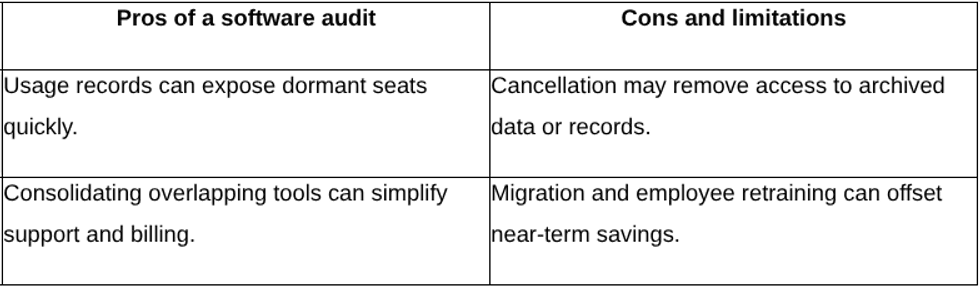
First, export a complete application inventory, including departmental tools purchased outside the central accounting process. Then compare paid seats with 30-day and 90-day active-user records. Three months of silence is a signal. Investigate whether you still need that license.
Find Overlap and Renewal Risk
Duplicated functions hide costs. Two teams may run separate products for project management or file storage, and each renewal compounds the overlap. A simple method works here:
- Export all recurring software payments from the accounting system.
- Match each charge to an owner, contract, renewal date, and active-user report.
- Cancel dormant seats before negotiating the plan level or contract length. Freeing that spend protects cash flow for the expenses that still earn their keep.
2. Reprice Insurance Without Creating Coverage Gaps
Compare Exposure, Limits, and Exclusions
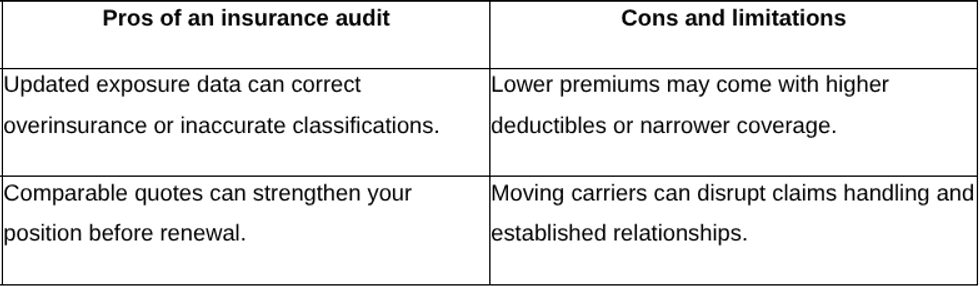
Premium alone tells you little. An insurance audit compares the policy's stated assumptions with current operations, because property values, payroll, and revenue can all change during a policy year. A company that added vehicles or a second location may be carrying outdated classifications or limits.
Review Deductibles and Loss History
Deductible changes and claims history affect the price. So does a misclassified operation class or an endorsement nobody remembers requesting. Before renewal, request comparable proposals with the same limits and exclusions; otherwise you are comparing labels, not coverage. Cutting limits can convert a manageable premium into a severe uninsured loss, so weigh the risk before accepting the savings.
3. Put Vendor Contracts on a Renewal Calendar
Calculate the Full Cost of Each Agreement
Invoice price is only part of vendor cost. Include minimum purchases and automatic price increases in the total, as well as support fees and the employee hours spent managing the relationship. These expenses compound quietly when a business lacks a central contract record.
Negotiate Before the Cancellation Window Closes
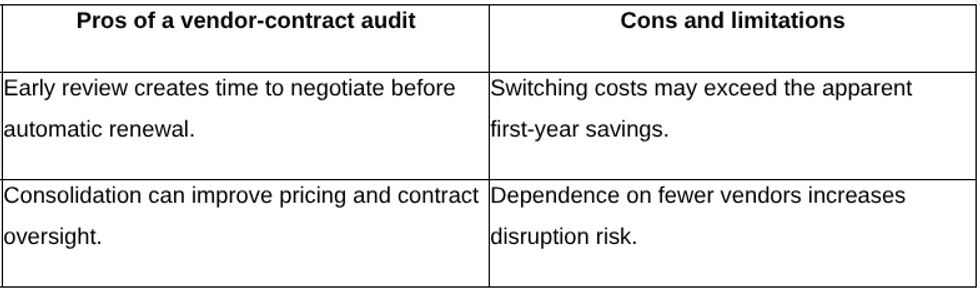
Keep one central record of contract owners, notice deadlines, and renewal dates. A 60-day review is too late when an agreement requires 90 days' written notice, and automatic renewal clauses rarely excuse a missed deadline. Set the first review at least 120 days before expiration so you can negotiate while alternatives still exist.
Consolidation deserves care. Fewer vendors can improve pricing and simplify oversight, but concentrating purchases with one supplier raises disruption risk if that supplier struggles. Track vendor performance against agreed key performance indicators before shortening the list.
4. Examine Staffing Costs Without Reducing the Review to Layoffs
Track Cost by Role and Workload
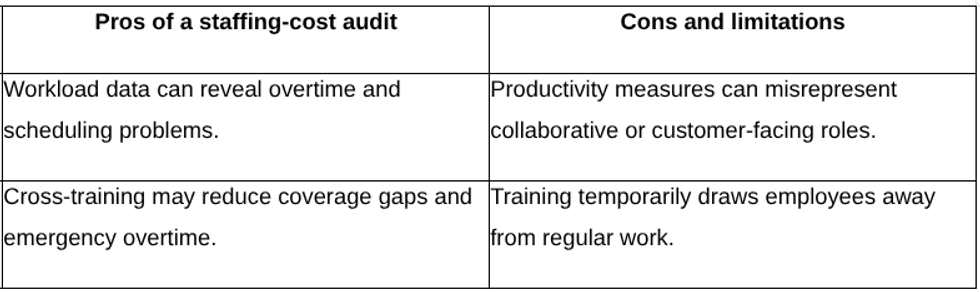
Headcount reduction is not the default answer. Forbes Advisor's small-business statistics put labor at roughly 70% of total spending for many small businesses. That general benchmark may not reflect your cost structure. A staffing audit should review scheduled hours and overtime by role, then vacancies and benefits, so you can see which hours produce which results.
Fix Scheduling and Process Problems
Repeated overtime usually signals something structural. Poor scheduling and broken processes generate overtime that extra effort will not fix. Limited cross-training does the same. Compare scheduled hours with actual customer demand by day and shift, then correct the mismatch at its source. Do not pay a permanent premium for it.
Decide When Automation or Outsourcing Fits
Automation and outside services change the calculation for repetitive work. Weigh an employee's ongoing cost against outside service fees and response time. Account for the institutional knowledge that may walk out the door when a task moves to an outside firm.
5. Audit the Business Electricity Costs Texas Companies Can Control
Read the Whole Bill, Not Only the Advertised Rate
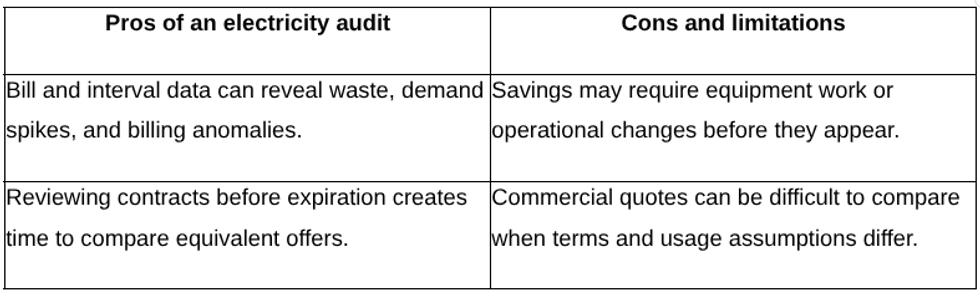
Review the whole bill, not just the headline rate. A Texas business electricity audit should start with billed kilowatt-hours and the energy rate. Next, review delivery charges, demand charges (where they apply), taxes, and account fees. Include contract dates in the same review, and make sure the meter data matches your operating hours.
Energy consumption is measured in kilowatt-hours. Peak demand is measured in kilowatts. The two drive separate charges, and not every small-business plan uses the same demand structure, so inspect your bill and contract before assuming anything.
Compare 12 months of bills against operating hours and occupancy, then against production schedules and weather-sensitive equipment. You are hunting patterns; a single-month anomaly tells you little. Watch for sudden jumps in consumption or in miscellaneous account fees. Record the contract expiration date and the notice period it requires, then compare offers against your company's actual usage profile, never against a teaser rate designed for a hypothetical customer.
How Fixed and Variable Electricity Rates Affect a Small Business
A fixed-rate plan generally stabilizes the contracted energy price for its term, while a variable-rate plan can move with market conditions or plan rules. Neither structure fixes the entire bill, because usage and regulated delivery charges still vary. So do taxes and plan fees. Fixed does not mean identical: a business that uses more electricity will generally owe more even when its energy rate is locked.
When you compare plans, review the full contract term and the pricing structure before you look at the advertised cents-per-kilowatt-hour figure. The same discipline applies to Texas small businesses of every size. A contract that matches your operation for its full term matters more than a rate that looks good for one month.
How to Reduce Business Electricity Costs in Texas
A small Texas business can cut its power bill several ways. Correct billing errors first. If the rate structure rewards it, shift flexible loads away from peak periods. Maintain high-consumption equipment and align schedules with actual occupancy. Compare contracts before the renewal deadline, not after.
Intact refrigeration seals and repaired compressed-air leaks trim kilowatt-hours. So do HVAC schedules matched to occupancy and lighting controls set correctly. One caution, though: switching suppliers doesn't fix inefficient consumption, and better usage habits don't fix an expensive contract. The two fixes address different parts of the bill, so evaluate both.
Current Business Electricity Rates in Texas
Texas has no universal commercial rate. Your quote reflects where you operate, how much power you use, and the term and market conditions when you shop. The U.S. Energy Information Administration Electricity Data Browser publishes historical Texas commercial averages, but those averages are not live retail offers. Your current quote will reflect your account's location and usage profile, not the statewide mean.
How a Business Electricity Bill Is Calculated
Multiply consumption by the applicable energy price. Add delivery charges and taxes, plus demand charges and plan-specific fees where they apply. Two companies drawing the same kilowatt-hours can end up with different bills because peak demand and contract terms differ from account to account.
Finding the Lowest Business Electricity Rate
No supplier is cheapest for every Texas business. Commercial pricing reflects the account's location and load shape; the contract start date and requested term matter just as much. The lowest advertised rate can turn expensive once usage thresholds and contract conditions apply.
A Good Electricity Price Per kWh in Texas
A good price is an all-in quote that holds up against offers written for the same service area and usage pattern. Compare the energy component and the total estimated bill separately, then treat the latest EIA commercial average as historical context only. A universal target rate published without those qualifications is not a reliable benchmark for an individual business.
Why Electricity Bills Rise in Texas
A Texas bill usually rises for plain reasons. Higher usage is the most common. A changed contract rate comes next. New fees and market conditions at renewal round out the list. Compare the current bill with the same billing period from the previous year, and separate usage changes from rate and fee changes before deciding what caused the increase.
Make the Next Renewal Easier
The method matters more than the category. Recurring expenses become manageable when each one has a named owner and a review date on the calendar. Run the same test on every recurring line item: ask what it costs and what it produces, then ask when the contract lets you decide next. A disciplined review schedule turns recurring charges back into deliberate, predictable decisions.
Post sponsored by SearchEye
About the Author
Post by:Chris Porteous
Chris Porteous is the CEO of SearchEye, a company that offers a unique line of marketing services for clients and agencies across the globe. Prior to setting up his own company, he worked for prestigious financial institutions such as Goldman Sachs, UBS Securities, and DBRS. He regularly shares his insights on business and finance on Entrepreneur, Forbes, Due, and many other reputable websites.
Company: SearchEye
Website: https://searcheye.io/